
The City Arms of Lichfield

The City Arms of Lichfield are a well-known design and can be spotted in and around Lichfield and listed within books and journals.
I have a number of items within my collection of Lichfield memorabilia which contain the arms or the city and also those of the city seal, displaying the ‘legendary’ three slain Christian Kings of Lichfield.
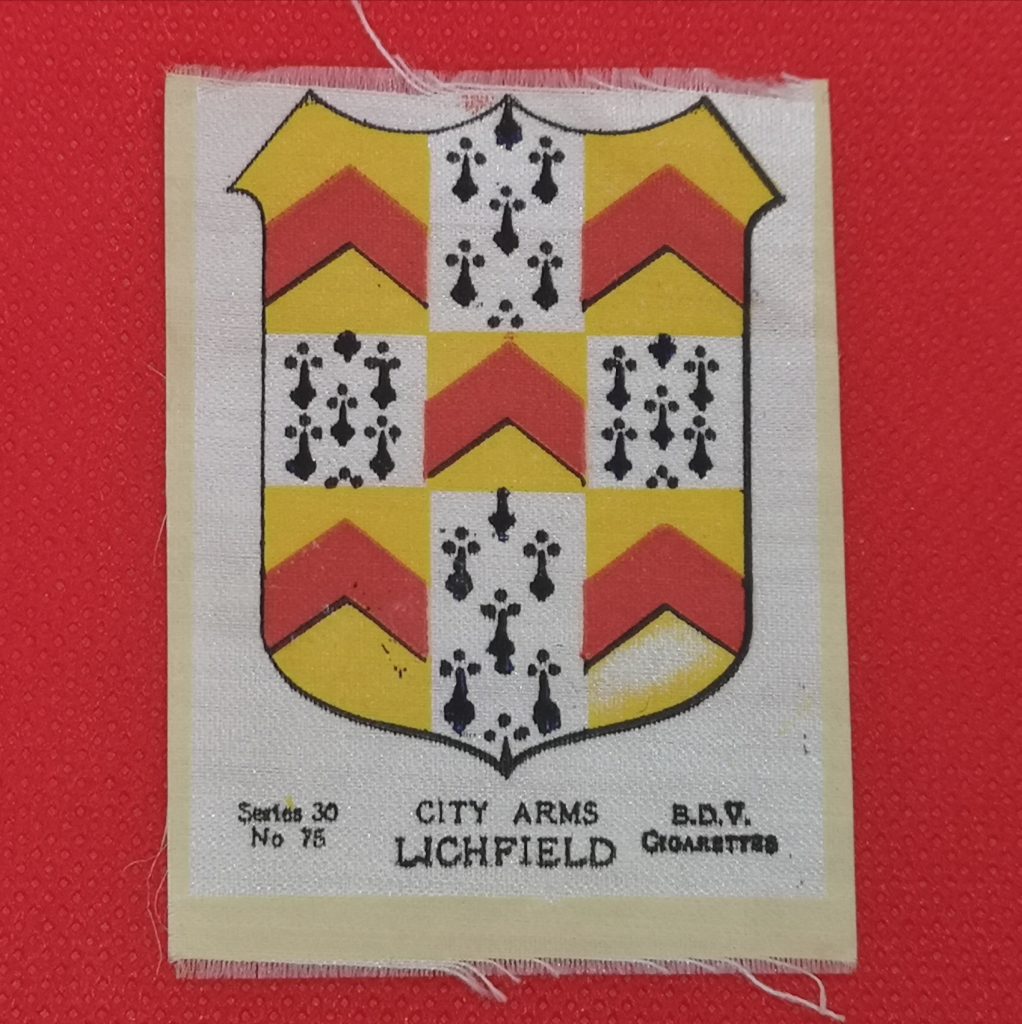
The first item is a cigarette ‘silk’ dating from around 1910 and showing the city arms of Lichfield. Silks were an alternative of the better known cigarette cards which were, at the time, very popular. The silks were placed in to the cigarette packets and were, just like the cards, very collectable. This Lichfied City Arms silk was placed in to a packet of B.D.V cigarettes which were produced by the Godfrey Phillips company, who were based in London. The brand was highly succesful, starting in the early-to-mid 1900’s and going through to 1948. The acronym B.D.V stood for ‘Boyd Dibrell Virginia’, the name of the American tobacco suppliers, based in West Virginia. Another legend has it that it was named by a member of the Phillips’ family using the Latin phrase ‘Benedictus Dominus Vobiscum’ which translates to ‘Pipe of Peace’. Now my school Latin is pretty rusty but I don’t think that sounds right to me! The silk was a limited edition and this was number 75 of Series 30, Town Arms. The arms show the red chevrons, believed to tbe the arms of the family Stafford, and pointed arrowheads. These arms can be see on the second item (below) and also at various points in and around the city, including within the ancient Guildhall
Godfrey Phillips, a London tobacconist, founded the company in 1844, it became a limited company in 1908 and opened its new headquarters at Commercial Street, in London, in 1936. In 1968 the company was acquired by the multi-national Philip Morris International Company, most famous for the Marlboro (and Marlboro ‘Man’ adverts!) cigarette brand.
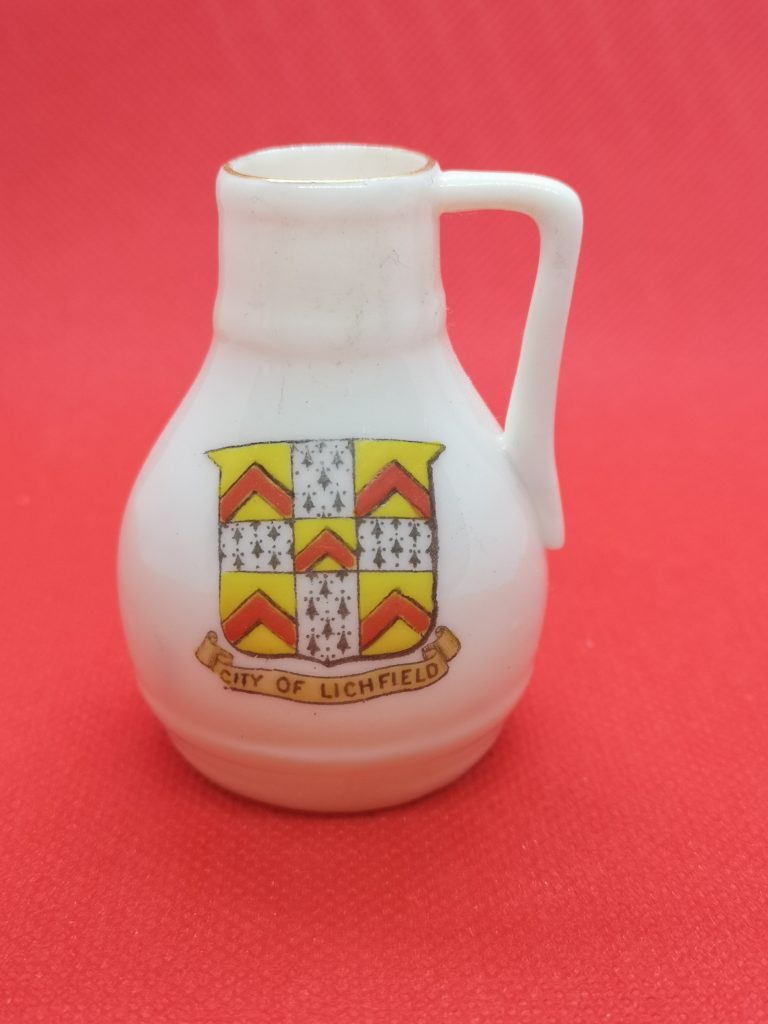
The second item is a small W.H. Goss ceramic jug, again with the chevron and arrowheads city arms on. The Goss pottery ware is very well known and, unlike the cigarette silks, are widely available.
William Henry Goss established the Falcon Factory, which was a family-run business, in Stoke-on-Trent and they produced their pottery from 1858 up until the 1920s when the company was sold to new owners and proudcution continued into the 1930s before it ceased trading.
The Goss pottery produced was almost entirely small pieces, which often had town or city arms added to them, or famous artefacts associated with a particular town or city. It also produced items which had the busts of famous people, for example Queen Victoria, and some featured cars and ships. One of their most collectable items are ceramic cottages, very traditional and typical of ‘Olde England’. The pottery was primarily produced to be small souvenir items, so that people would go from seaside town-to-town and collect a new piece of pottery at each stop. As the late Victorians discovered the joys of a typical English seaside resort, to the range became more and more popular. The use of the city arms, as in the Lichfiedl example,was also very popular and Goss ware became a style of heraldic china pottery. The Lichfied jar is modelled on an oak pitcher, peculiar to Devon. It is not dated, but from the markings on the base it is probably late 1890s to early 1900s.
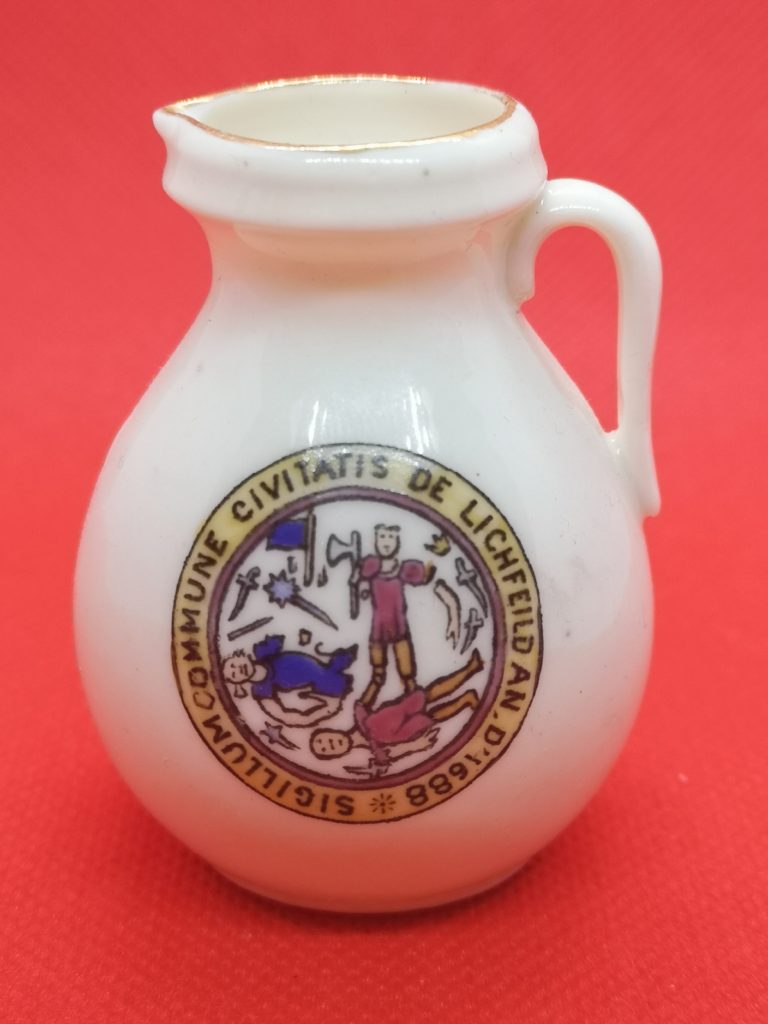
The third, and final item, is a another piece of Goss ware. This time it has a depiction of the ancient city seal, granted to Lichfield by the Royal Charter in 1548 at the time of King Edward VI. The seal was remodelled in 1688 and shows the three dead Christian Lichfield Kings on the battlefield, having been slain by a conquering Roman Legion in the 3rd century AD. This depection gives rise to the common legend that Lichfield was named after this disastrous episode in its history and being translated as: Field of the Dead. No direct archaelogical or historical evidence has ever been found to corroborate this – but it makes for a great story!
The description on the bottom of the pottery says that it is a model of an ‘ancient jug dug out of foundations of Lichfield Museum’. The Museum it refers to is the old Free Library and Museum on Bird Street / Beacon Street, now home to the Lichfield Registry Office. The museum was opened in 1859 and I’m unsure what happened to the original jug.
Again the jug is undated but will be similar in age to the City Arms model.
The City Arms, and the City Seal with the three kings, appear in a number of locations in the city and there are various versions of both in the Lichfield Guildhall on Bore Street – though this is inaccessible currently due to Covid-19 restrictions.
Locations you can see the City Seal on daily exercise walks though include the Rose Garden in Beacon Park, where the Martyr’s Plaque is located and on the Lichfield City railway bridge on Upper St John Street, on the city side of the bridge.
I hope you enjoy looking at my city arms and seal items and I will be displaying more of my Lichfield collection here soon!
Jono Oates
May 2 May 2020


